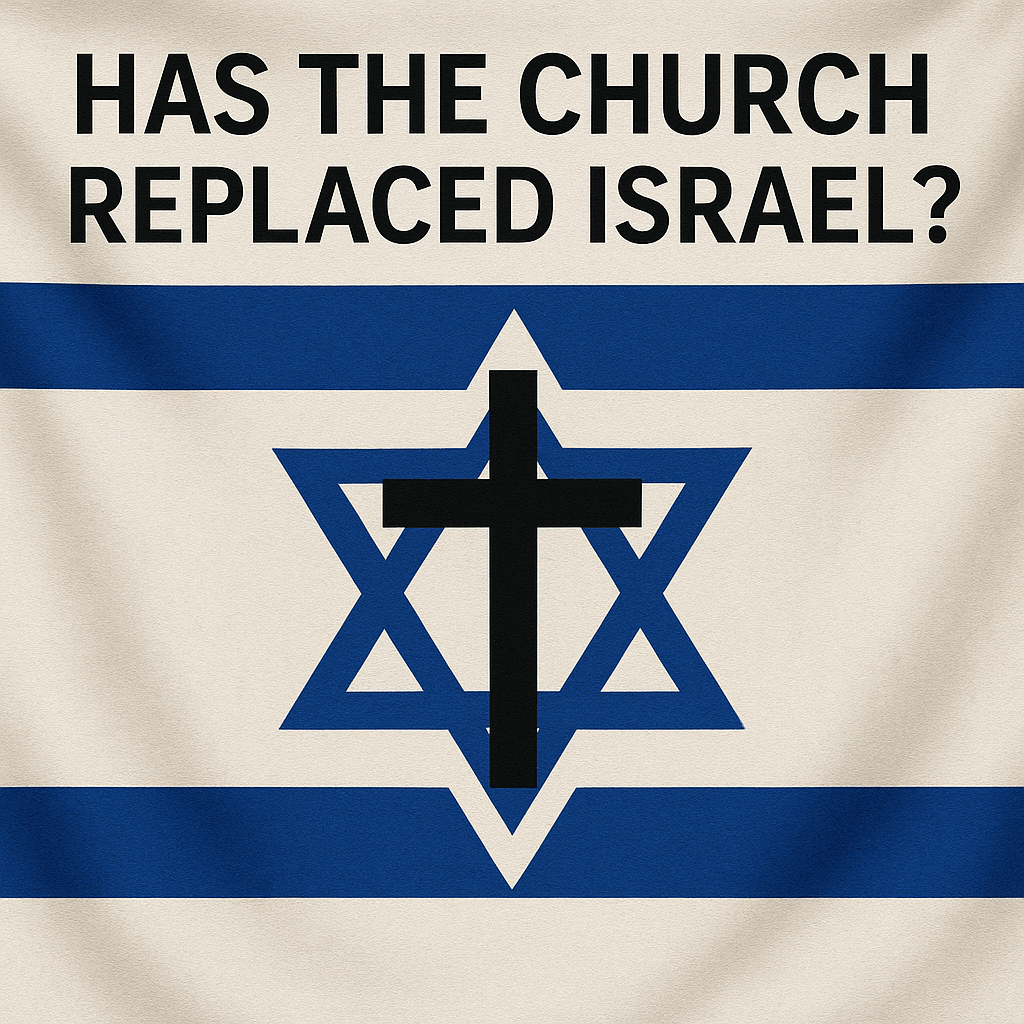
For a long time, since about 150 A.D., the answer to this question has been “yes.” As often happens in Biblical studies, scholars tend to mirror each other’s opinions as they read and discuss. So what came to be known as supersessionism or replacement theology was passed down to Bible teachers and the pastors they trained. As a result, the teaching that the church has replaced Israel became more widespread. It even persists in the church today.
Replacement theology developed into the disease of anti-Semitism. The malignant growth can be traced through history. John Chrysostom (349-407), known as “golden mouth” because he was the best preacher in the early church, taught that Jews murdered their children, offered sacrifices to Satan, and he even plainly declared, “I hate the Jews.”[1] Luther (1483-1546) said the Jew’s “synagogues should be burned, their houses razed, their prayer books seized, let them be reduced to a condition of agrarian servitude, and—as a “final solution”—let them be expelled from the country.”[2] This mistaken theology eventually spread from the church to the broader culture. The French Enlightenment philosopher Voltaire wrote that “a Jew is someone who should have engraved on his forehead “Fit to be hanged.””[3]
By the 1930s, replacement theology was deeply ingrained in German Christianity. It was the theological framework that justified the Nazi extermination of the Jews. Two current scholars write, “By the 1930s supersessionism was conditioned well into the fabric of German Christianity … the practical results of it led to Jewish expulsion, seizure of their property, and eventually extermination of millions in the concentration camps. One wonders whether, if the German churches had possessed a robust anti-supersessionist posture, Hitler and his ideology would be a mere footnote today.”[4] The rotten fruit of what came to be called replacement theology or supersessionism was what Jews call shoah, a word translated Holocaust.
The Holocaust was a wake up call to the church. It provoked a renewed theological and pastoral reflection on God’s regard for His nation. Of course, there have always been a remnant who compared what they heard from mainstream scholars, teachers, and pastors with the Bible. Faithful Biblicists, often not the scholars and pastors but those in the pew whose minds were bound by what they found through a plain reading of Scripture. They questioned how Israel could have been displaced when the Gospels of Matthew (Matt. 1:1-17) and Luke (3:23-38) feature genealogies that tie Jesus closely to the Nation of Israel. Or, if Israel wasn’t important anymore, then why did Jesus’ mother Mary rejoice that God chose her to be the mother of the Messiah promised to Israel (Luke 1:54-55)? Zechariah, filled with the Holy Spirit, prophesied that Jesus was a descendant of David (Luke 1:69), fulfilling God’s covenant with Israel (vv. 72-73). If it were true that the church replaced Israel, then why would Paul affirm that Israel was God’s beloved, and that their gifts and calling were irrevocable? They puzzled over what Jesus meant when He said He was going to fulfill the Law and Prophets (Mt. 5:17-18) if it didn’t mean that the covenants of land, seed, and blessing (Gen. 12:1-3) were not going to be fulfilled?
Next time I will survey some of the scholars who are rereading the Scriptures, reassessing replacement theology, and are laying a Biblical foundation for Christian Zionism.
[1] John Chrysostom, Discourses against Judaizing Christians, trans. Paul W. Harkins, vol. 68, The Fathers of the Church (Washington, DC: The Catholic University of America Press, 1979), 171.
[2] Hans J. Hillerbrand, “Introduction to Volume 5,” in Christian Life in the World, ed. Hans J. Hillerbrand, Kirsi I. Stjerna, and Timothy J. Wengert, vol. 5, The Annotated Luther (Minneapolis, MN: Fortress Press, 2017), 6.
[3] Gerald R. McDermott, The New Christian Zionism: Fresh Perspectives on Israel and the Land (Westmont, IL: IVP Academic, 2016), 41.
[4] Stanley E. Porter and Alan E. Kurschner, The Future Restoration of Israel: A Response to Supersessionism (Eugene, Oregon: Pickwick Publications, 2023).

 TheoFaith