Introduction
The tension in the drama of Esther peaks in this chapter. The decree has been issued—every Jew in the Persian Empire faces death. Mordecai, overwhelmed with grief, wears sackcloth and ashes and stands outside the palace gates, pleading for his people. When Queen Esther hears the news, she is safe inside the palace, but her people are not. The quiet courage of one woman and the faith of one man now stand between life and death for an entire nation.
A Crisis of Faith and Fear (vv. 1–8)
Mordecai’s lament spreads throughout every province of Persia. His anguish is not rooted in despair but in intercession. He understands that the covenant people cannot be destroyed, yet the threat remains real. Esther’s initial response reveals her humanity—she is afraid. Approaching the king without being summoned could cost her her life. She is torn between her fear for her life and her love for her people. In these verses, we see a vivid portrayal of our own struggle with obedience. Fear and faith often clash within the heart, but ultimately, faith finds strength in the character of God, who always keeps His word.
The Call to Courage (vv. 9–12)
Mordecai’s message to Esther is both serious and inspiring. He reminds her that staying silent will not protect her—sooner or later, her identity as a Jew will be discovered. Mordecai’s wisdom shines here: he does not manipulate Esther with guilt but instead bases his appeal on God’s promise and providence. Deliverance will happen, but Esther has the chance to be the one God uses to bring it about.
The Interplay of Sovereignty and Responsibility (vv. 13–14)
These two verses form the theological heart of the entire book: “If you keep silent at this time, relief and deliverance will rise for the Jews from another place, but you and your father’s house will perish. And who knows whether you have come to the kingdom for such a time as this?”
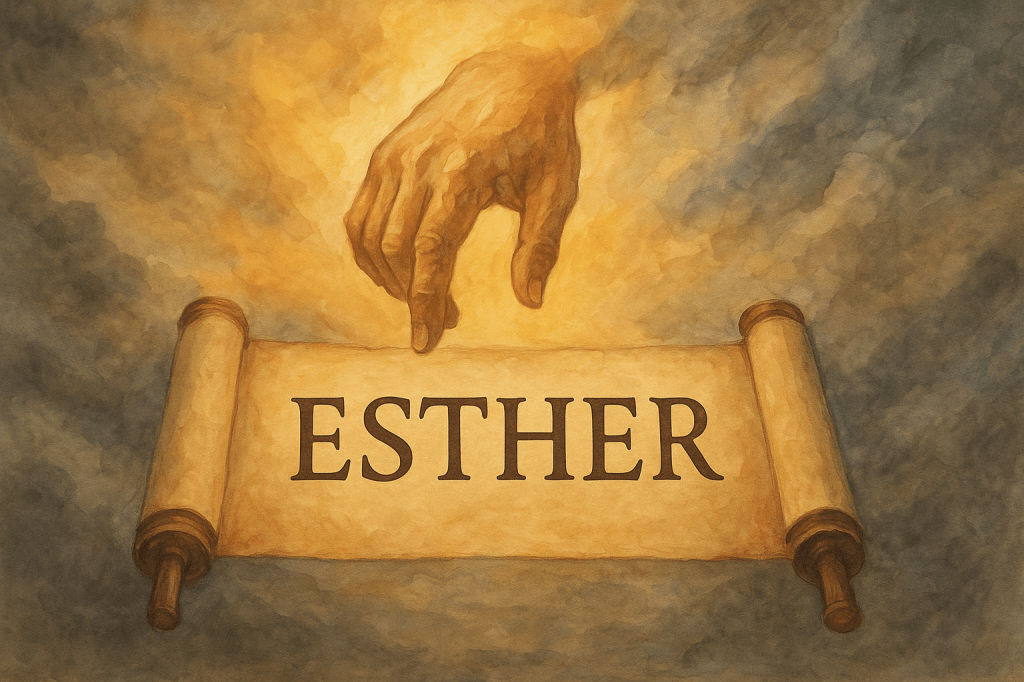
Mordecai’s words remind us of the gentle yet unwavering hand of God’s sovereignty intertwined with our own call to responsibility. God’s promise to Israel in Genesis 12:3 assures us that His care and preservation are steadfast. Yet, just as Esther was called to step out in obedience, we too are invited to trust and act faithfully, knowing that Providence does not absolve us from responsibility but empowers us to participate in God’s divine plan. God’s omniscience sees every detail of our lives, and His sovereignty guides all events so that His loving purposes are fulfilled — even through our hesitations and uncertainties.
Courage in the Face of Fear (vv. 15–17)
Esther’s response marks a turning point: “Go, gather all the Jews who are present in Susa, and fast for me… Then I will go to the king, though it is against the law; and if I perish, I perish.” Her fear is not gone—but it is now governed by faith. She calls for fasting, signaling dependence on God, not on her position or her beauty. In that moment, the timid young queen becomes a courageous instrument in the hands of the Sovereign Lord.
This is not reckless bravery but holy boldness—the kind that trusts the unseen hand of God, the One who “works all things according to the counsel of His will” (Eph. 1:11).
Theology of Esther 4
The fourth chapter of Esther is a compelling reminder that God’s sovereignty and our responsibility are woven together in a beautiful and reassuring way. God is in control, guiding His plan, but He also invites us to step forward in faith and action. Mordecai’s trust in God’s preservation encourages us not to despair or become passive, and Esther’s courage inspires us to trust in God’s plan as we serve Him with boldness and hope.
In this chapter, we see that God’s unwavering faithfulness to His chosen people, Israel, is the heart of this entire story. Even when His name isn’t explicitly spoken in the book, His promises and covenant faithfulness quietly uphold everything behind the scenes. The same God who called Abraham’s descendants remains faithful and loyal, even during times of exile and hardship. His sovereign hand carefully guides history, ensuring that His plan of redemption unfolds just as He has purposed, offering us hope and assurance in His steadfast love.
Takeaway for Today
Courage is not the absence of fear but faith in the face of fear. Like Esther, today we are placed in specific circumstances, families, workplaces, and communities “for such a time as this.” Like Israel, we are far from our true home and God sometimes seems far off. We do not control the times, but we serve the One who does. Faithful obedience—however small it may seem—becomes the means through which God accomplishes His eternal purposes.
Questions for Reflection
How might courage in your life today influence the faith of those who come after you?
What fears or obstacles keep you from acting in obedience when God calls you to speak or serve?
How does Esther 4:13–14 help you understand the relationship between God’s sovereignty and your responsibility?
In what ways has God positioned you uniquely “for such a time as this”?

 TheoFaith